Buying guide
Before you place a bulk rice order: 5 things every buyer should check
Most disputes between rice buyers and suppliers don’t start with bad rice. They start with an order that was placed on trust instead of specifications — a phone call, a rough idea of “the usual grade,” and a truck that shows up three weeks later carrying something slightly different from what was expected. Here’s what to pin down before you confirm any bulk order, whether you’re a distributor, a hotel kitchen, or a kirana chain buying under your own label.
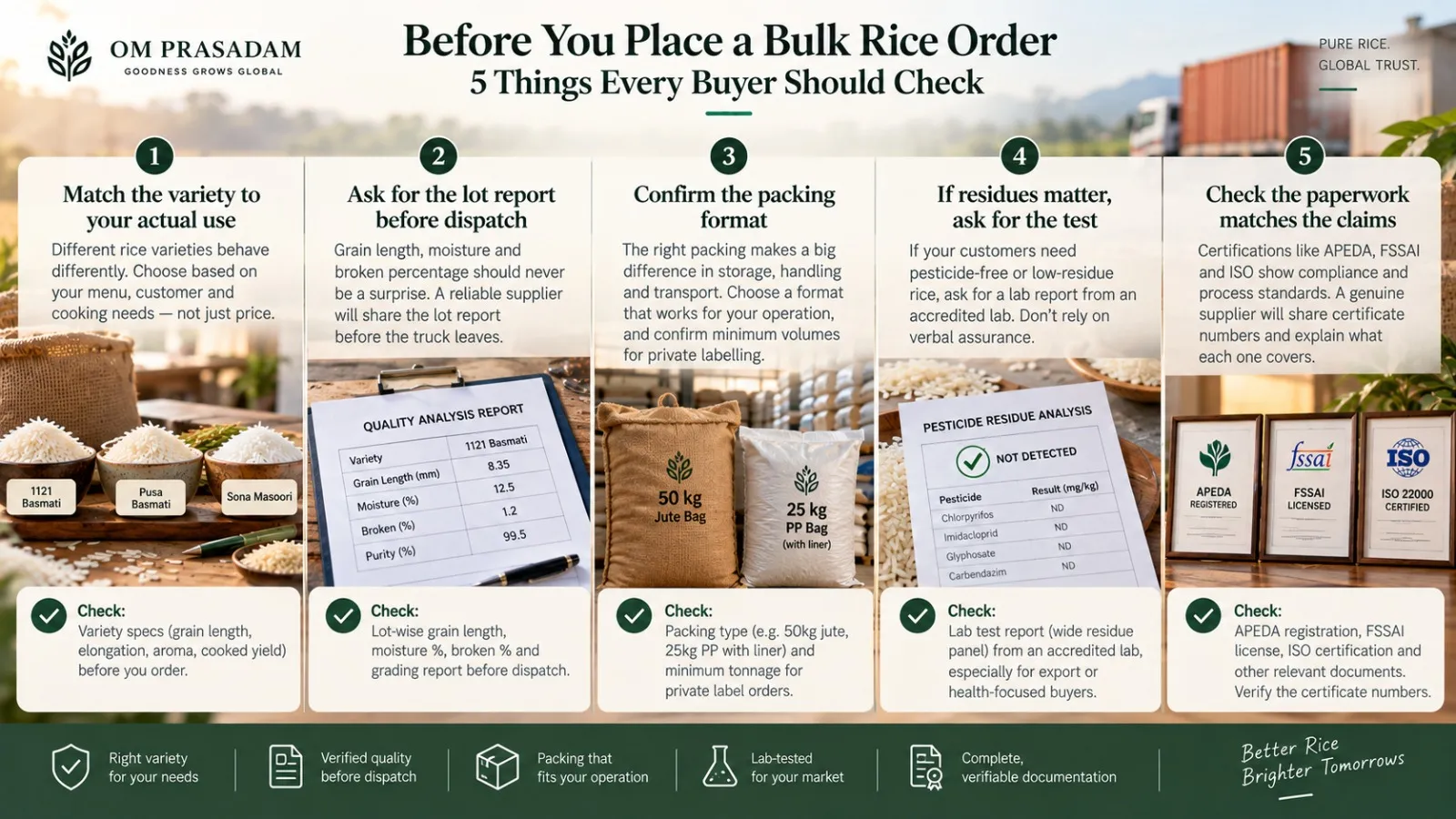
1. Match the variety to the actual use, not just the price
1121 Basmati and Sona Masoori are both “rice,” but they behave completely differently in a pot — different elongation, different cooked yield, different price band. A caterer buying Basmati for a wedding menu and a canteen buying for daily service have different priorities, and the Basmati rice range is built around exactly that distinction, with separate specification sheets for 1121, Pusa, 1509, 1401 and 1718.
2. Ask for the lot report before dispatch, not after
Grain length, moisture percentage and broken percentage should never be a surprise on delivery. A supplier who mills to spec will have this data recorded per lot and will send it before the truck leaves, not after you’ve already unloaded it.
3. Confirm the packing format matches your handling capacity
A 50kg jute sack and a 25kg PP bag with a liner move very differently through a small kitchen versus a mandi warehouse. If you’re printing your own label, ask what the minimum tonnage per design is — most mills won’t run a private-label batch below a certain volume, and knowing that number early saves a renegotiation later.
4. If the end buyer cares about residues, ask for the test — don’t assume it
“Pesticide-free” and “low residue” mean different things depending on who’s saying it. If your own customer — a European retailer, a health-conscious household chain, an export buyer — needs documented proof, look for rice milled on a dedicated line and tested against a wide residue panel at an accredited lab, like the pesticide residue free rice range, rather than a conventional lot with a verbal assurance attached.
5. Check the paperwork trail matches the claims on the website
APEDA registration, FSSAI licensing, ISO certification — these aren’t marketing badges, they’re checkable registrations. A supplier who’s serious about compliance will show you the certificate numbers and explain what each one actually covers, not just list the logos. You can see how this mill documents its own process on the about page, including intake checks, ageing, sortex sorting and lab testing.
None of this takes long to ask for. It just has to be asked before the order is confirmed, not after the rice is already in your warehouse.